A theory of evolution
Shane Holland, Chair of the Borough Market charitable trust, on the market’s gradual evolution and the principles and imperatives that are driving it
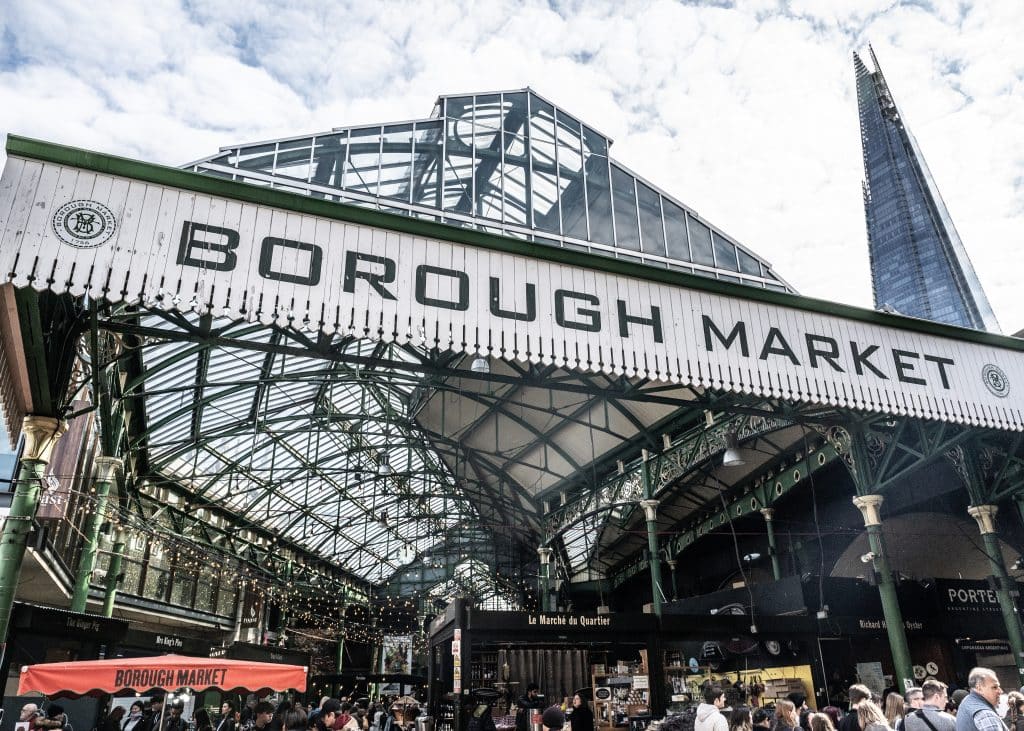
“TODAY, BOROUGH MARKET SEEKS TO SERVE THE PUBLIC BY OFFERING A MUCH-NEEDED ALTERNATIVE TO THE STATUS QUO”
Words; Shane Holland / Images: Sim Canetty-Clarke
For the trustees of the charity that oversees Borough Market, the task is far from simple. Our responsibility, summarised in our official charitable purpose, is to provide a market that functions “for the benefit of the public”. This legally binding obligation, drafted several generations back, is unusually broad by modern standards. Our role is to both interpret and apply it.
In the market’s 20th-century incarnation, when Borough was a fruit and veg wholesale hub, the charity could benefit the public simply by supplying the greengrocers who fed south London. Today, in a very different landscape, we interpret our responsibility in a completely different way. Back then, the market was a vital cog inside the mainstream food system. Now, we seek to serve the public by offering a much-needed alternative to the status quo.
In the most general of terms, we do this by providing a home for small-scale, specialist businesses. We benefit them by offering affordable rents, service charge subsidies, consistently high footfall, and the power of the Borough Market brand. In turn, we benefit the wider public by supporting modes of food production that emphasise sustainability, transparency and ethical practices, and offering access to food and drink they would struggle to find on a regular high street. For the trust, profit is not a motive. Principles are what matter.
To understand the breadth of these principles, a good place to start is with the charity’s Food Policy. Published in 2022, this document is helping bring clarity and consistency to Borough Market’s food offering. Its aim is to ensure that the trust’s vision for an alternative form of food retail, based on sustainable practices, animal welfare and opportunities for small businesses, is fully reflected out on the market floor. Many of the changes that are currently taking place at Borough, some celebrated, some a source of controversy, are being driven by the slow, complex implementation of this policy.
Among the first to feel the effects of the Food Policy were new applicants hoping to secure an open spot at the market, who found themselves having to jump through even more hoops to prove their alignment with the trust’s principles. Amending the application process was the easy bit, though. Much harder and more emotionally charged is the need to apply equal rigour to established traders whose livelihoods are tied to the market and whose sense of connection is understandably strong. Some have been here for years, others for entire generations, making this the place it is today.
Over the past few years, the effort of embedding the Food Policy, as well as other policies and standards, has been constant, collaborative and impactful. Thanks to our existing traders’ willingness to respond, numerous improvements have already been made to the quality and consistency of the market’s offering. For individual businesses, the stress point comes when their current lease begins to expire. Before offering any new agreement, we now engage in a detailed assessment of the trader’s alignment with the trust’s policies, and how committed they are to narrowing any gaps. Food is of course central to this, but so too is the daily experience of shoppers, staff and fellow traders.
This expiry process is designed to be nuanced and even-handed. It’s not a tick list, not a simple pass or fail. Around a third of our tenants and stallholders have already moved through the process, and the vast majority have been offered a new agreement. Sometimes an agreed set of development goals has been worked into the lease to help support the trader’s evolution. On the rare occasions when we take the decision not to offer a new lease, it is never taken lightly and is highly unlikely to boil down to a single area of misalignment.
This more stringent approach is, we believe, worth the effort. And there is recent precedent to suggest as much. The evolution of the market’s restaurant estate has, in recent years, been rapid, visible and much lauded, and none of it has happened by accident. For decades, the selection of restaurant tenants was not underpinned by an explicit set of principles, and there was very little oversight of what the operators did once they got here. Now, the demands placed on potential new tenants, or existing tenants seeking to earn a new lease, are immeasurably higher. And with rents set fairly and independently, all have been chosen for their alignment with the trust’s policies and values, rather than the depth of their pockets.
Restaurants also provide a glimpse of one of the main complicating factors in the market’s evolution. For historical reasons, not every restaurant space on the perimeter of the Market is controlled by the trust. Sixteen of them are – enough that their occupants go a long way towards shaping the reputation of Borough Market – but if a chain outlet opens in one of the others, nothing can be done about it. Similar quirks of history and property law mean that a handful of traders on the market floor are subject to a different type of lease than their neighbours, one that gives them far greater latitude over what they sell. Our belief is that adherence to our food policy benefits the entire market community, but that doesn’t mean these stallholders are under any obligation to comply.
Zooming out a little, applying the principles of the Food Policy goes beyond individual traders. Our role as trustees is also one of curation. It’s important for Borough Market to reflect the diversity and dynamism of its host city. It needs to adapt to changes in the wider world. It needs to offer opportunities for new businesses as well as support for established ones. This is a place that has always evolved. The market’s remarkable facility for transformation is one of the reasons it is still here, sitting unscathed on a prime piece of central London real estate. Generation after generation, its trustees have realised that change is hard, but change is good. It brings new ideas, new perspectives, new benefits.
It is our job to facilitate that change. Only by ensuring the market evolves and thrives can we provide the all-important public good.
Shane Holland is the Chair of Trustees of Borough Market